
Restaurants can reduce food delivery commission fees by adding their own ordering system, so customers order directly instead of through apps like DoorDash or Uber Eats. Tools like RestroFood let restaurants take orders on their own website, keep the full sale amount, and skip the 15–30% commission cut that third-party apps charge on every order.
Table of Contents
A commission fees are the cut a delivery app takes from every order a restaurant sells through it. A customer orders a $20 pizza. The app keeps a slice of that $20 before the restaurant sees any money. This slice is the commission fee.
Most US delivery apps, including DoorDash, Uber Eats, and Grubhub, charge between 15% and 30% per order. This range depends on the plan the restaurant picks and the services included, like marketing placement or delivery drivers. A restaurant on a higher plan gets better visibility in the app, but pays a bigger cut.
This fee comes out before the restaurant pays for food, labor, and rent. A restaurant owner sees the full order amount on paper, but only a smaller number lands in the bank account.
Delivery apps say the fee covers three things: the driver’s pay, the app’s marketing, and the app’s technology. These are real costs. Someone has to pay the driver who brings the food to the customer’s door. Someone has to pay for the app that customers use to place the order.
The problem is scale. A large restaurant chain can absorb a 20% cut because it sells thousands of orders a day. A small restaurant with 50 orders a day feels every dollar of that cut. A $30 order can lose $6 to $9 to fees alone, before any other cost.
Small and mid-size restaurants run on thin profit margins already, often between 3% and 9%, according to National Restaurant Association data from 2023. A 20% commission fee on one channel can erase most of that margin on every delivery sale.
A restaurant owner can estimate monthly commission loss with three simple steps.
Here’s an example. A restaurant sells $10,000 through a delivery app in one month. The app charges a 25% commission. That restaurant loses $2,500 in one month to that single app. Over a year, this restaurant loses $30,000, money that could have covered rent, new equipment, or staff wages.
These numbers vary by restaurant size, city, and app plan, so treat this as a starting range rather than an exact figure. Even a conservative 15% commission on the same $10,000 in monthly sales still removes $1,500 every month.
This is the part many restaurant owners miss. The delivery app, not the restaurant, often controls key parts of the sale.
The app decides how the restaurant’s menu appears to customers. The app decides which restaurants show up first in search results, and a restaurant that doesn’t pay for premium placement can get buried below competitors. The app also keeps the customer’s contact information, order history, and preferences. The restaurant rarely gets this data back.
This matters because repeat customers are the most profitable customers. A restaurant that can’t reach its own customers directly can’t run a loyalty program, send a birthday discount, or announce a new menu item without going through the app’s system.
This lack of control is the real reason restaurants look for alternatives. See how RestroFood puts this control back in the restaurant’s hands →
The table below compares three major US delivery apps against RestroFood, a WooCommerce-based restaurant management plugin for WordPress. RestroFood runs on a restaurant’s own website, so the restaurant owns the platform instead of renting space on someone else’s app.
| Feature | DoorDash | Uber Eats | Grubhub | RestroFood |
| Commission per order | 15–30% | 15–30% | 15–30% | 0%, one-time plugin cost |
| Owns customer data | App | App | App | Restaurant |
| Menu control | Limited | Limited | Limited | Full |
| Own website ordering | No | No | No | Yes |
| Built-in POS | No | No | No | Yes |
| Delivery driver tracking | App-only | App-only | App-only | Real-time |
| Multi-branch management | No | No | No | Yes |
This table shows a clear pattern. The three delivery apps charge a recurring commission on every order, and the restaurant never fully owns the customer relationship or the platform. RestroFood works differently: a restaurant buys the plugin once, installs it on its own WordPress site, and keeps 100% of every order placed through it, along with the customer data that comes with each sale.
RestroFood installs directly on a WordPress website using WooCommerce, the e-commerce platform that powers millions of online stores. A restaurant does not need a separate app or a new website. It adds RestroFood to the site it already has, or builds a new one.
Setting up commission-free ordering takes a few clear steps.
Once this is live, every order that comes through the restaurant’s own website skips the third-party commission entirely.
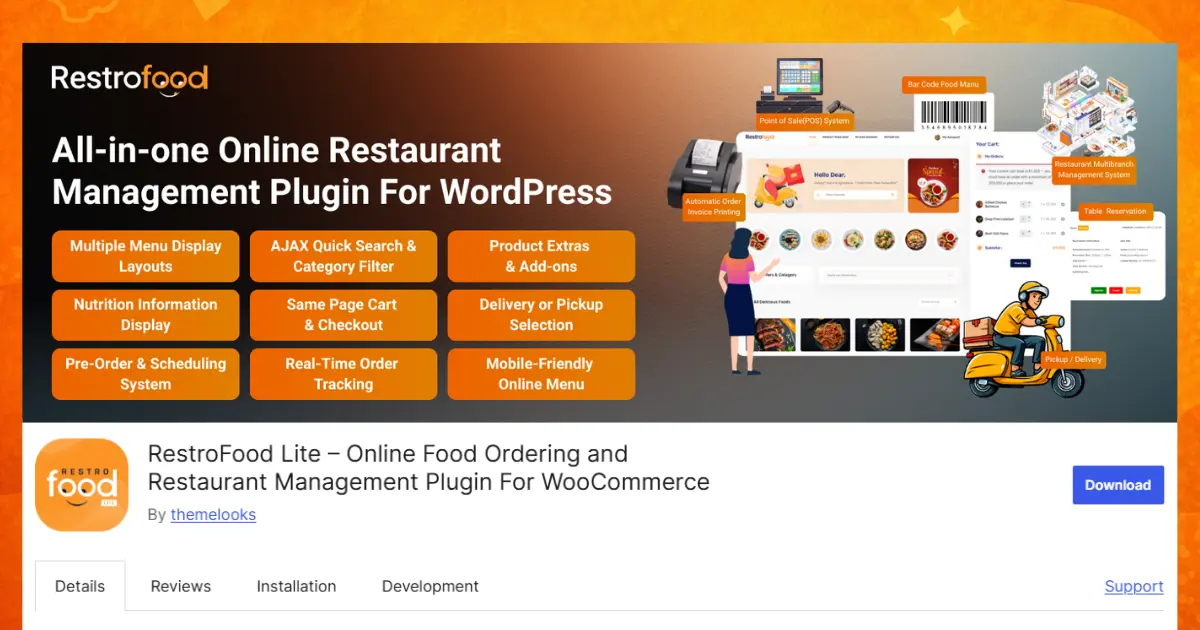
RestroFood was built to remove the specific costs and control problems that come with third-party delivery apps.
A restaurant needs more than online ordering. Staff also need a fast way to take orders from customers who visit the restaurant. RestroFood includes a built-in Point of Sale (POS) system, so you don’t need to buy separate POS software. Staff can quickly take dine-in, takeaway, or phone orders from one screen. The system prints receipts, sends orders directly to the kitchen, and keeps everything organized. This helps restaurants serve customers faster, reduce mistakes, and save money on extra software.
Customers like knowing where their food is. RestroFood lets restaurants track their own delivery drivers in Real Time Tracking. Managers can see each driver’s location on a map and check the status of every delivery. If a customer asks when their order will arrive, staff can give an accurate update in seconds. This improves customer trust, makes deliveries more efficient, and removes the need to depend on third-party delivery apps.
Running more than one restaurant can be difficult if each location has its own system. RestroFood makes it easy by letting you Manage Multi-Branches from one dashboard. You can update menus, prices, and settings for every location without logging into multiple accounts. Orders from each branch stay organized, and managers can monitor performance from one place. This saves time and keeps every restaurant running smoothly.
Good business decisions start with good data. RestroFood provides detailed reports that show your sales, orders, popular menu items, and business performance in one place. You can view reports for online orders, takeaway, dine-in, and every restaurant branch together. These insights help you understand what customers buy most, identify your busiest hours, and make smarter decisions to grow your restaurant and increase profits. Explore all RestroFood features →
A restaurant does not need to stop using delivery apps right away. Many successful restaurants use both delivery apps and their own online ordering system. Delivery apps help bring in new customers, while a direct ordering system helps earn more profit.
Here are some signs that it’s time to add your own online ordering system:
Using delivery apps and your own ordering system together is often the best strategy. Delivery apps help attract new customers, while direct online orders help your restaurant earn more, build stronger customer relationships, and grow over time.
Two trends are shaping how restaurants handle delivery in 2026.
Both trends point in the same direction: restaurants want more control over their own sales data, pricing, and customer relationships, without giving up the convenience customers expect.
Third-party delivery apps can help restaurants reach new customers, but the commission fees can reduce profits over time. Building your own online ordering system is a smart way to keep more of every sale while giving customers a simple and direct way to order. RestroFood makes this easy by combining online ordering, a built-in POS system, real-time delivery tracking, multi-branch management, and detailed sales reports in one WordPress plugin. You stay in control of your menu, customer data, and business without paying commission on every order. For restaurants that want to grow, improve customer relationships, and increase profits, RestroFood is a practical, long-term solution that helps your business succeed today and continue growing in the future.
A commission fee is the percentage a delivery app keeps from every order sold through it. This typically ranges from 15% to 30% per order, depending on the app and the plan the restaurant selects. The restaurant receives the remaining amount after this cut.
These apps charge for driver pay, marketing placement, and the technology behind the ordering system. The fee covers real operating costs, but it applies at the same rate whether a restaurant sells 10 orders or 1,000 orders a day, which hits small restaurants harder.
A restaurant can avoid commission fees by adding its own ordering system on its website, using a tool like RestroFood. Orders placed directly through the restaurant’s site skip the third-party app entirely, so no commission applies.
The delivery app usually owns the customer’s contact details and order history, not the restaurant. This makes it hard to send a direct offer or reminder to a repeat customer without going through the app’s own marketing system.
A restaurant can set this up on its existing WordPress website using WooCommerce and the RestroFood plugin. The setup covers menu upload, order type selection, and publishing the ordering page for customers.
It makes sense once monthly commission costs consistently outweigh the cost of running an owned ordering system, which for many restaurants happens once delivery sales pass a few thousand dollars a month.
RestroFood uses a one-time plugin cost instead of a recurring percentage cut. A restaurant losing $1,500 to $2,500 a month in app commissions typically recovers the plugin cost within the first few months of switching orders to its own site.
Our FAQs cover the most common questions about ThemeLooks. If you need personalized advice or have a unique query, our team is ready to help. Contact us!
Mohammad Nur Alam is a Technical Content Writer at ThemeLooks Ltd., specializing in WordPress, SaaS, SEO, and web development. He writes practical tutorials, product reviews, and technical guides that help users make the most of WordPress tools and plugins. Passionate about digital marketing and emerging technologies, he enjoys creating helpful content and staying up to date with the latest industry trends.
